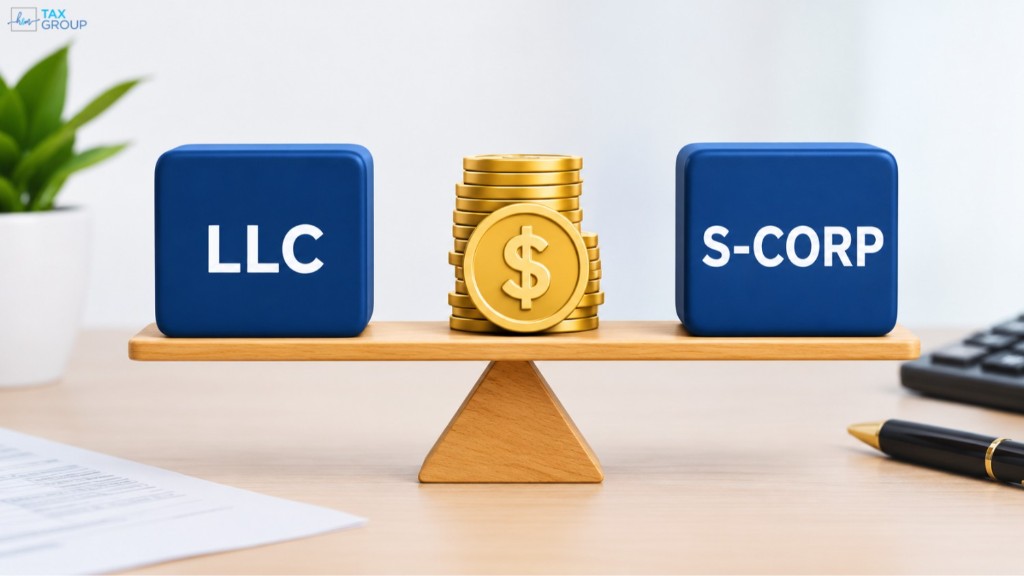
If you’re a business owner and wish to retain more of your earnings every year, then you should read on. Great news: You’ve come to the right place! When it comes to your business, one of the biggest decisions you have to make is how your business is set up. Many owners wonder, “LLC vs S-Corp Which is better for taxes?” That will depend on your income, your objectives, and your day-to-day work. We’re clearing up these two choices in basic terms in this blog. You will find out how each one is taxed, where tax savings for a business owner can be obtained, and what you should consider before deciding. Let’s get started!
What’s an LLC and an S-Corp, and how are they different?
LLCs are legal business structures that are created in your state. It helps keep your personal things separate from business debts. An S Corp is not a type of business. A tax election made with the IRS. An LLC or a corporation may request to be taxed as an S-Corp. One is a structure and one is a tax status.
Understanding LLCs and S-Corps
An LLC is the business house. The S-Corp election is a decision regarding how the IRS counts the dollars inside of that house. It is possible to opt to choose S-Corp taxes later and still keep your LLC. A common question new owners ask is LLC vs. S Corp vs C Corp: Which is best for your startup in 2025?
What is the nature of the Tax treatment of an LLC, and what types of taxes will the owner most likely be subject to?
If you have a single owner of an LLC, it will be taxed as a sole proprietorship by default. If the LLC has two or more members, it will be treated as a partnership for tax purposes. Typically, the business is not liable to pay federal income tax. However, the profits are not “kept” by the company, but instead are “passed through” to the owners. Each owner reports a profit on a personal tax return and pays income tax and self-employment tax.
How LLCs Are Taxed
- Profit goes to your personal tax return, which generally means that there is one layer of tax.
- Self-employment tax is 15.3% of your net profit, with the exception that you may be able to claim a tax credit if the net profit exceeds $52,000.
- This tax pays for Social Security and Medicare.
- Estimated tax payments may be required four times a year.
- When Filling Business Taxes for LLC for the First Time, many new owners feel uncertain and without records that will go a long way to make this easier.
What is the S-Corp tax regime and how is the owner’s earnings treated under the S-Corp regime?
An S-Corp is also a pass-through entity for income tax. Profit is still reported on your personal tax return. The difference comes in the way you’ll be paid. If you are part of the business, you’ll be an employee and need to pay yourself a reasonable salary. The balance of the profit can be paid to you as a distribution and is taxed differently for payroll taxes.
How are S-Corps taxed? What are the taxes on S-Corps?
- Your payroll goes through payroll and Social Security and Medicare taxes are deducted.
- These payroll taxes are not usually levied on distributions.
- The S-Corp itself reports on its own tax return (Form 1120-S) every year.
- A Schedule K-1 is provided to each owner detailing his or her share of profit.
- There will be additional expenses like payroll services, more paperwork and state fees.
- You’ll be held to a standard of a fair salary by the IRS.
What are the benefits to S-Corp taxation for qualifying business owners in terms of lowering their self-employment tax?
For an LLC, the self-employment tax is applied to the majority of your profits. For an S-Corp, payroll taxes are largely the case where they pertain to your salary. Generally, distributions over that amount escape those taxes. That’s where the savings from self-employment tax can be found. However, the compensation needs to be reasonable and new expenses can diminish the savings. Every individual business owner has their own unique math.
Potential SE Tax Savings:
Here’s a simple rule that many tax professionals follow: Consider switching to an S-Corp when profit increases significantly over a reasonable salary. At lower levels, the incremental costs will likely exceed the incremental benefits. H&M Tax Group’s knowledgeable staff compares both options with your actual numbers so you can see which is the better option for your business before you decide.

Conclusion
So, is it better to be an LLC or S-Corp for taxes? Unfortunately, the truth is that it depends on your profit, your income and your objectives. An LLC makes things simple. Self employment tax savings may exist but come with payroll and paperwork for an S-Corp. Seek expert advice before going through the transition. H&M Tax Group is a local tax advisory group specializing in assisting business owners to accurately and carefully file their taxes. Our income tax filing, bookkeeping, and QuickBooks services ensure that your bookkeeping is clean throughout the year. Call H&M Tax Group today and discuss tax savings for business owners such as you.