
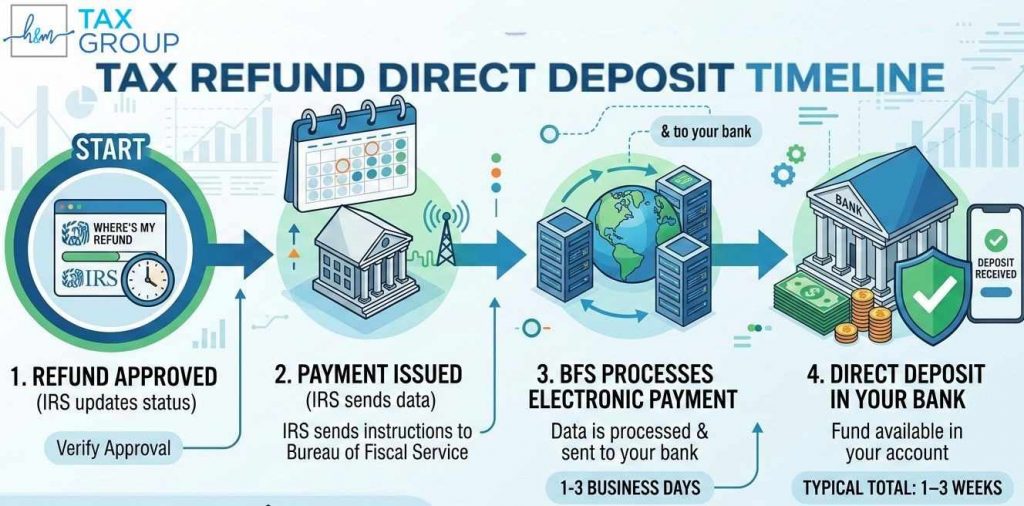
It is a thrilling experience to get your tax refund, and even more so, you will know that the IRS’s Where is my refund tool shows approved. Then there is the waiting game: when will that money be deposited into your bank account? Learning the tax refund process time and the timeline of the IRS refund direct deposit will alleviate the worry of having unrealized expectations, in that you are constantly monitoring the balance of your bank account, wondering what happened to your money. The process of taking your refund to the bank and getting money in your account takes many steps and various institutions, with each step having a minor processing time.
How many days on average does a tax refund take before it is deposited in your bank account once it has been approved by the IRS?
Once the IRS has agreed upon your refund, you can usually count on the money appearing in your bank account in 1 to 5 business days, although the vast majority of individuals have their money within 2 to 3 business days. The refund deposit process begins when the IRS issues your payment to the Bureau of Fiscal Service of the Treasury Department, which then electronically transfers the refund into your bank account. The deposit order is received by your bank and credited to your account, and this may either take one or many business days, depending on the processing mechanisms of your respective financial institution.
Comparison of Speeds of Bank Processing
- Faster banks: A few financial institutions and credit unions post IRS direct deposits immediately they receive them, usually within 24 hours after IRS transmission, that is, you may get your refund only a day or two after approval displays on Where’s My Refund.
- Slow Banks: other banks only verify or process transactions in batches on certain days, and so may take 3 to 5 business days after the IRS sent it to them before it appears in your account.
What follows after IRS approves your tax refund?
After the IRS finishes processing your refund, the Where’s My Refund tool changes to indicate the status of the refund as approved and an approximate date of direct deposit. At this stage, the IRS has already completed processing your return and is verifying the amount of the refund that you are getting. Your approved refund is then sent by the IRS to the Bureau of Fiscal Service, which processes all federal government payments such as tax refunds. The electronic payment is sent to your bank by the Bureau of Fiscal Service based on your routing and account numbers that you gave on your tax filing. Understanding this processing stage explains why you cannot receive your money immediately after approval.
Bank Deposit and posting schedule.
Once the electronic deposit instruction has been received by your bank through the Bureau of Fiscal Service, the bank starts to process it internally. Banks are normally notified in advance of the impending IRS deposits, usually a number of days prior to the date of the deposits.
Why could a tax refund take more time to show up in your bank account, even after it has been approved?
There are a number of reasons that may lengthen the IRS refund direct deposit period to more than the standard 1-5 days. Processing is slowed down by weekends and federal holidays since the Bureau of Fiscal Service and banks do not process transactions on these days; a Friday approval may not be paid until the next Tuesday or Wednesday. Incorrect banking details on your tax filing result in a lot of waiting time since the IRS has to issue a paper cheque rather than a direct bank deposit, which increases the time of the tax refund by 2-4 weeks. Refunds can be delayed or reduced under the offset program, which intercepts refunds of unpaid debts such as student loans, child support, or state taxes.
Identity Verification Requests
- Information checking requests: When the IRS suspects that your return might be stolen, they issue you a letter asking that you verify your identity before you receive your refund – timely response to these requests saves weeks or months of further stalling of your money.
- Secondary refunds purporting some tax credits, such as the Earned Income Tax Credit (EITC) or Additional Child Tax Credit (ACTC): By law, secondary review periods are required, which may hold refunds until mid-February when no earlier filed and approved returns have been approved.
How to Monitor Your Refund and How to Prevent Delays.
Checking your refund status with the IRS Where’s My Refund tool will also give you updates on the progress of the process and when you can expect your refund. This tool is updated daily, normally overnight, and therefore, there will be no new information by looking into it multiple times in a day. To prevent future tax year delays, be sure to use all the banking information on your return fully and without errors, which includes routing numbers and account numbers. Filing early during the tax season helps one get ahead of processing backlogs that arise towards the end of April. Above all, file correct returns that do not get IRS attention. The professional income tax reporting services of H&M Tax Group will leave your returns comprehensive and correct, reducing the chances of delays in processing and optimizing the chances of holding the refund.
Delay Minimization through Professional Tax Preparation
To guarantee smooth sailing in the processing of tax refunds, it is always best to file the correct and complete returns that do not attract the oversight of the IRS and are not rejected. Professional tax planning detects problem areas prior to filing, makes sure that there are supporting documents for your deductions and credits and makes sure that the information used in direct deposit is accurate. The all-inclusive services of H&M Tax Group, such as income tax filing, bookkeeping, and QuickBooks services, keep your financial statement in order throughout the year, thereby making it easier to do tax preparation and lessen the chances of making mistakes in filing that would slow down the receipt of refunds.

Conclusion
Filing taxes correctly and on time means that the refund process will be as smooth as possible, and any needless delays will be reduced. H&M Tax Group has our tax professionals, who are the best in the field and offer expert income tax filing services that make sure your returns are filed out in totality, correctly, and efficiently processed to help in gaining the maximum period of the timeline of the refund.