
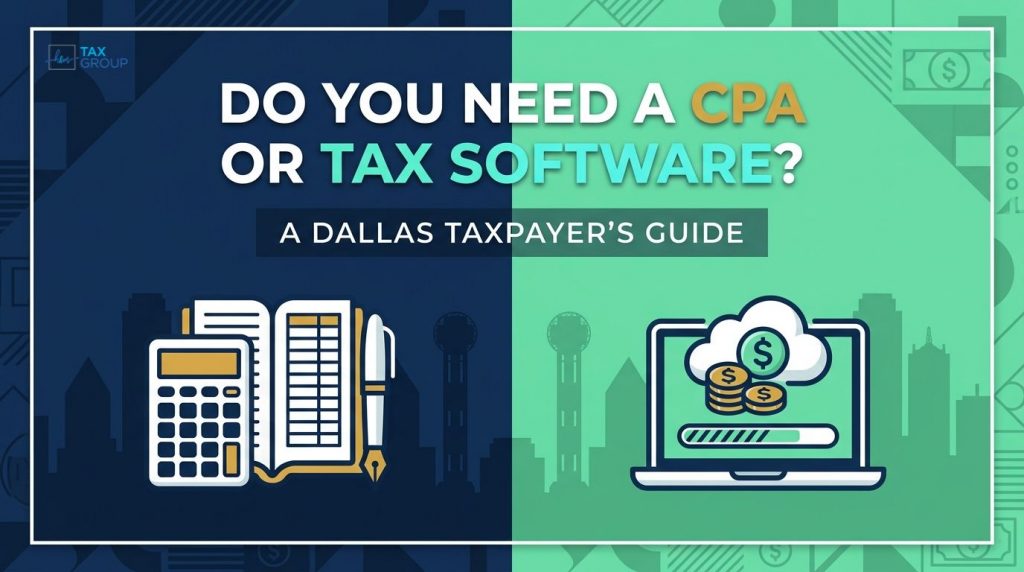
Each filing season, the issue is the same for Dallas taxpayers: Do I do it myself using tax software, or should I hire a professional? Both choices have strengths and they both have their weaknesses. It all depends on your finances, your return’s complexity, and your knowledge of tax. Here’s a breakdown of the main differences that you should be aware of before making a decision before the deadline.
What’s the Difference Between Using a CPA and Tax Software to File Taxes?
Tax software is an online program that walks you through a typical tax return, asking and answering questions. It uses simple tax principles for automatic calculations based on the information you enter. A CPA is a licensed professional who will take a look at your overall financial picture, identify deductions you might be missing, and provide judgment that cannot be matched by software. They can both file a return, but the process between opening the program and submission is very different.
Personalized Expertise vs Automated Filing
Tax software is computer software built on programmed rules. It will process what you input and provide warnings for glaring mistakes, but it cannot ask deeper questions, point out missed opportunities, or recognize when your situation requires a different strategy.
A CPA also provides professional insight, stays updated on tax law changes, and adjusts your filing strategy to your unique circumstances, which becomes crucial when your income is unusual, your deductions are complex, or your life has undergone major changes.
When Is Tax Software Not Enough to Do Your Tax Return?
Tax software is a sound choice for certain taxpayers. When your finances are simple — one job, one type of deduction, little or no investments, no self-employment income, and no major life changes over the last year — software can complete your return quickly and affordably. Many reputable platforms provide walkthroughs of each section, helping avoid common math mistakes. This is a practical and straightforward solution for simple tax returns when the information entered is correct.
When Does It Make Sense for Dallas Taxpayers to Hire a CPA vs. Software?
The more complicated your finances become, the more valuable professional guidance becomes. Software is designed for standard situations. Once your circumstances move beyond that norm, the risk of filing errors, missed deductions, or costly mistakes increases. As businesses grow, taxpayers develop multiple income streams, or acquire larger assets, the expertise of a licensed CPA familiar with both federal tax law and the Texas financial environment becomes increasingly important for Dallas residents.
Advanced Tax Issues and Financial Planning
- Self-employment and business income create deductions, estimated payments, and entity structure complications that software often cannot handle consistently or thoroughly.
- Major life events like marriage, divorce, adding a dependent, receiving an inheritance, or selling a home or investment can create tax consequences that cannot always be addressed through simple software prompts.
- Rental property deductions, depreciation, capital gains treatment, and passive activity rules are easy to misapply without professional guidance.
- IRS notices and previous-year filing errors are situations where software provides very limited support.
What Is the Accuracy and Support Provided by CPA Services Compared to Tax Software?
Accuracy is not just about math; it’s about applying the correct rules to the right situations. Software is accurate only when the information entered is correct and the tax situation is straightforward. However, if information is entered incorrectly or the situation falls outside the software’s expected logic, the software may process the return without identifying deeper problems.
A CPA reviews your information with professional judgment and asks the questions necessary to identify gaps before they become serious issues.
Monitoring and Direct Guidance for Error Prevention
A computer program can catch mathematical mistakes, but not strategic ones. Software may process incorrect income categories, missed deductions, or incorrect filing statuses while still producing a mathematically correct but factually inaccurate return.
A CPA is not only available during filing season but throughout the year. With bookkeeping and QuickBooks services from H&M Tax Group, your financial records remain clean and organized year-round, making tax filing faster, more accurate, and less stressful.
Audit support also makes a major difference. Software cannot represent you before the IRS. When it matters most, an experienced CPA from H&M Tax Group can answer questions, prepare documentation, and advocate on your behalf.

Conclusion
If you’re filing a very simple tax return, tax software can be a practical option. For more complex financial situations, however, working with a professional is often the better choice, especially for Dallas taxpayers who want confidence that their return is accurate, complete, and optimized.
H&M Tax Group is a reputable Dallas CPA firm that provides income tax filing, bookkeeping, and QuickBooks services to individuals and businesses of all sizes. If you’re unsure which option is best for your situation, consulting a professional is a smart first step.