
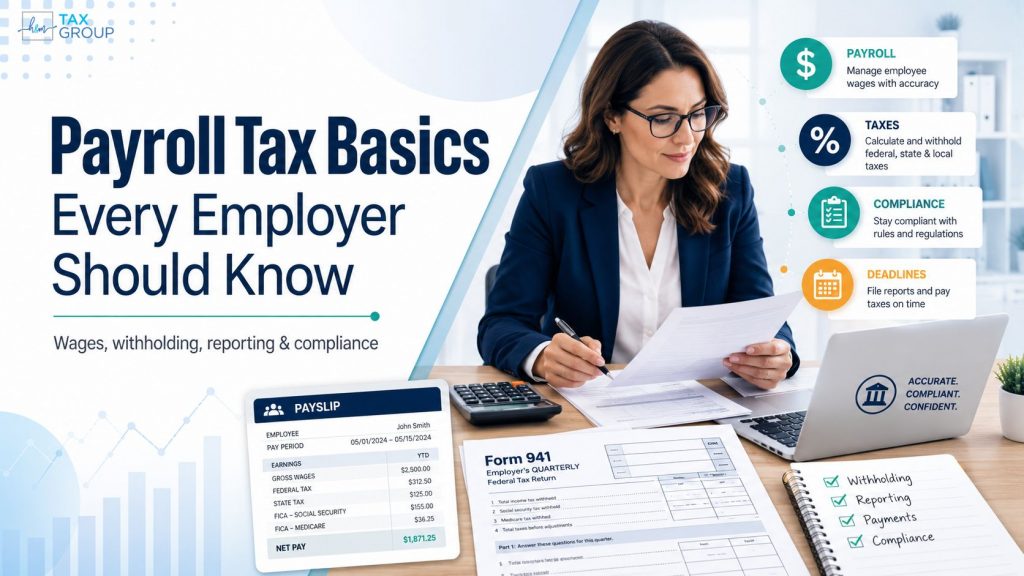
Payroll taxes are a financial obligation an employer has to keep up with, and one of the most important and often overlooked. As soon as you start your first worker, payroll tax responsibilities for employers start, and they are not an option. Payroll tax mistakes have serious financial implications, such as fines, interest, and IRS investigation. This blog provides each employer with a straightforward explanation of payroll taxes, what’s involved, and how to be compliant with the peace of mind.
What Are Payroll Taxes and What Makes Employers Responsible for These Payroll Taxes?
Payroll taxes are taxes levied on employee wages that employers must withhold, match and submit to the proper taxing authorities in accordance with a routine schedule. Employer tax obligations are not limited to just withholding from an employee’s paycheck — employment taxes start as soon as wages are paid. Employers have a double responsibility: to withhold their employee’s share, and to match their employee’s contribution. If either requirement is not fulfilled, even if due to inadvertence, penalties are charged by the IRS and quickly add up to cost.
Employer Tax Obligations
- Employers are in charge of withholding federal income tax from each employee’s paycheck based on what’s on the employee’s W-4 form that got filed, and also based on the number of allowances, then they have to deposit that withheld amount to the IRS on a timing plan set by the IRS itself.
- FICA taxes means Social Security plus Medicare taxes, and those are taken out from wages and then, employers match them on a payroll dollar-for-dollar basis each pay period, even if it s just a normal payroll cycle or otherwise.
- The Federal Unemployment Tax (FUTA) isn’t something that gets withheld from employee wages, instead it’s on the employer alone to pay over to the federal government, basically to help fund federal unemployment insurance programs.
- As for state payroll tax burdens, they’re not all the same by state and can include state income tax withholding and state unemployment insurance tax, and for some states there can be additional local payroll taxes that sit above the federal piece.
What are the Federal, State and Local Payroll Taxes that Employers are required to withhold and pay?
Being aware of all of the payroll tax obligations of employers is knowing what taxes are owed, who is responsible for them and where they go. The list is more in-depth than most new employers realize and leaving out even one category is one of the most frequent and costly employer tax errors H&M Tax Group sees when reviewing employer files.
Understanding key tax types and requirements for filing.
- Federal income tax withholding will be handled by looking at each employee’s W-4, and it’ll be subtracted either semi-weekly or monthly , depending on the employer’s total tax bill, but yeah the deposits have to happen on time, otherwise penalties can show up for late deposits.
- FICA taxes are basically made up of 6.2% of the employee’s wages for Social Security and 1.45% of the employee’s wages for Medicare, then there’s an extra 0.9% Medicare surtax once pay goes over certain limits for higher wage earners, and all of this is matched dollar for dollar by the employer too.
- For FUTA, the employer pays it at 6% of the first $7,000 of each employee’s yearly wages, though there’s a credit up to 5.4% for companies that pay their state unemployment taxes on time and in full.
As for state and local payroll taxes, those are set mostly by where the employer is located, and they can include things like state income tax withholding, state disability insurance, state unemployment insurance, along with local city and county taxes, which vary a lot depending on the area.
What is the process for calculating payroll taxes for both employee and employer?
Calculating payroll taxes is not a “one size fits all” situation; it relies on employee payroll and their filing status, rates of pay, and whether there are wage base limits. One of the most common payroll processing mistakes found in payroll audits is a miscalculation in this area that can add up over a series of payrolls before it’s detected.
Wages, Withholdings, and Matching Contributions
- Federal income tax withholding is based on gross wages, IRS tax tables and the employee’s W-4 information applied to gross wages on each pay period, and adjusted based on filing status, pay frequency and the amount of additional tax withholding that the employee chose on their W-4.
- FICA payroll tax is simple and derived from gross wages: 6.2% for Social Security up to the annual wage base ($176,100 for 2025) and 1.45% for Medicare (no wage cap), the employer pays the same percentage out of his own funds, separately from the employee.
- Employer tax obligations include keeping accurate records of earnings for each employee during the year to ensure proper application of wage base limits, determining when Social Security withholding ends and notifying high earners who are subject to the extra Medicare surtax before year-end tax filing deadlines.
What Payroll Tax Forms and Deadlines Should Every Employer Know?
Payroll tax compliance is not only about calculating the correct numbers; it’s about the correct forms on the correct dates. One of the most common reasons that employers receive IRS notices, receive penalties and interest charges, and can have these avoided is because they missed a deadline or filled out a form that was incorrect.
Reporting requirements and due dates.
Form 941 is a quarterly report that employers report federal income tax, Medicare tax and Social Security withholdings. Form 940 is the annual FUTA tax liability. Employees must receive their W-2s and must have them filed with the SSA by January 31st of the year they are issued. Employer-lookback periods determine the frequency of deadlines for deposits (semi-weekly or monthly), and they must be adhered to without delay or the employer will be subject to penalties.
H&M Tax Group provides income tax filing, bookkeeping, and QuickBooks services to keep the payroll records of Dallas-area employers accurate and up to date, and ensure they are filing on time and meeting all federal and state payroll tax requirements all year long. Don’t let payroll tax errors snowball because they are easier to fix early than late – seek professional assistance.

Conclusion
Payroll taxes are a mandatory expense of the employer, and there’s more to it than paying the right amount the right way with the right intention. Keeping your business compliant and your IRS account clean depends on accurate calculations, timely deposits, correct form filing and clean records. H&M Tax Group is the Dallas CPA facility that thoroughly examines payroll tax returns, identifies problems that are not spotted by other firms, and provides the expert advice required that your employer could not do without when filing payroll taxes.