
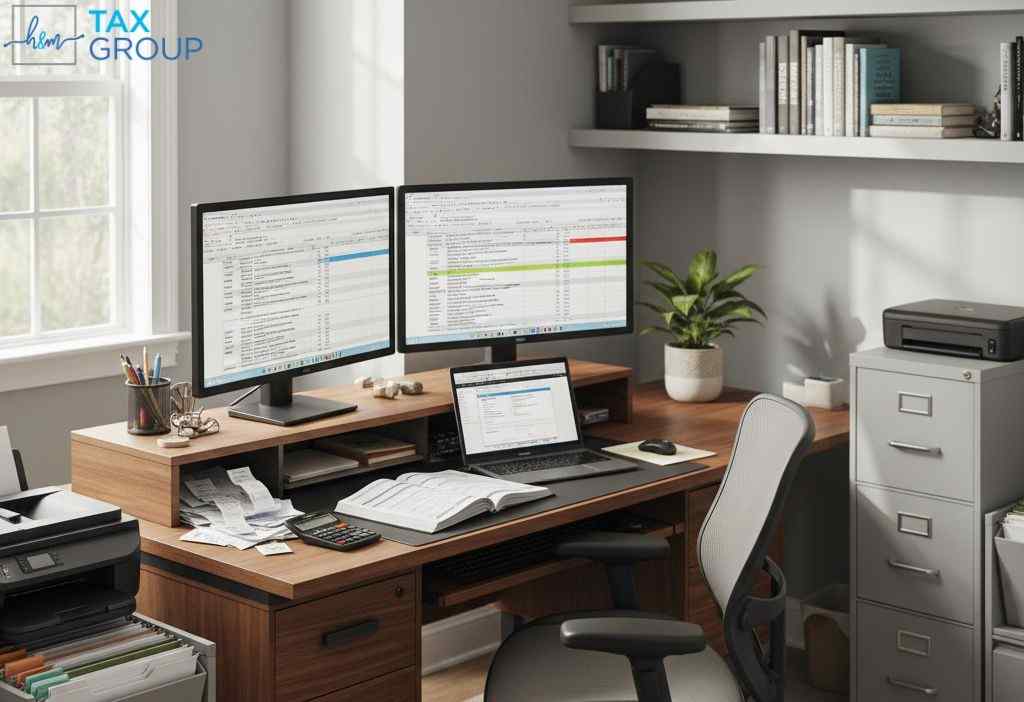
Home business is convenient and comfortable, yet it has tax advantages that most business owners fail to make the most of. The federal home office tax deduction is a very beneficial tax reduction that can make a big difference in your tax bill if you know the regulations and use them properly. To the Dallas small business owners, understanding the proper claim of such a deduction is equal to having more money in your pocket. We will discuss the IRS requirements and how we can take this valuable tax break and remain perfectly in compliance with it.
What does the IRS mean by enabling small business owners to deduct their home office on their taxes?
The requirement for a home office tax deduction is that small business owners have to demonstrate that their workspace meets the IRS criteria of exclusive and frequent business use. The space should be your key business location or any other place where you visit frequently with clients.
Self-employed individuals report this deduction on Schedule C of their tax filing. The home office deduction may cover a portion of rent and mortgage interest, utilities, insurance, and repairs, depending on the percentage of your home you use for business. The income tax filing services offered by H&M Tax Group are useful in assisting Dallas businesspeople in correctly calculating and recording these deductions to ensure that the filing is done in compliance with the maximum deductions as legally allowed, as far as a valid tax reduction is concerned.
General Eligibility and Qualification Requirements.
- Has to use the space solely for business.
- Space should be utilized on a regular basis, not as an exception.
- It should be the main place of business or the place of a client meeting.
- Independent contractors and self-employed persons are eligible.
- W-2 employees are usually not eligible (although exceptions are rare).
The home office should be both necessary for your business and used in the ordinary course of business activities.
Introductions to Deduction Methods.
- Streamlined: $5 a square foot through a 300-square-foot limit.
- The actual expense method: This method calculates actual costs in terms of the business percentage.
- The simplified method is less documented and easier to keep records.
- The actual expense method could give greater deductions for greater expenses.
A selection of approaches can be made every year, depending on which one will be more useful to you.
Who should be eligible to claim the home office deduction as a small business owner?
Home deduction is a good business expense mainly benefiting individuals who are self-employed, freelancers, and independent contractors who conduct their business in residences. To claim this deduction, you have to provide Schedule C with business income and expenses. The partners and the members of the LLC can also qualify based on their business structure.
The space must be used exclusively and regularly for business purposes. W-2 workers are not usually in a position to claim such a deduction because the tax law modifications abolished unreimbursed employee expense deductions. The bookkeeping services offered by H&M Tax Group assist an owner of a small business to keep proper records that can be used to claim tax deductions for a home office when the IRS conducts a review.
Self-Employed versus W-2 Employee Regulations.
- Self-employed persons: Can deduct it provided they pass exclusive and regular use tests, include it on Schedule C, and keep good records of business expenses and home office space.
- W-2 employees: After changes to the tax law in 2017, most W-2 employees, even full-time working remotely, may not deduct home office expenses, except when they are statutory employees in special categories, or when they are military reservists with qualifying circumstances.
What should pass as a deductible home office?
The IRS strictly defines a deductible home office based on exclusive business use. You cannot use a kitchen table that also serves personal purposes, but a separate spare bedroom used only for business qualifies. The space should be utilized continuously; in other words, there should be continuous and regular business activity in the space. It must be your major business location where you are carrying out significant administrative or management business. By fulfilling these requirements, the business use of the home is legitimate and resists the scrutiny by the IRS. H&M Tax Group assists Dallas businesspeople in identifying the qualifying spaces correctly and keeping records to prove claimed work-from-home deductions.
IRS Definitions of a Home Office
The IRS refers to a qualifying home office as that place where business is conducted on a regular basis. Exclusive use. This implies that the premises are not used by individuals but by businesses only. Regular use implies that you use the space regularly and not as an occasional business space. The space should be your main office of operation or where you usually receive clients or customers in the line of business.
Authorized Areas and Designs.
- Specialized additional rooms converted into offices.
- Separate buildings, such as garages or studios, are used purely for business.
- Basement or attic rooms used exclusively for business.
- One part of a room is divided by a solid partition and used solely for business.
- Additional rooms, as long as you use them solely and regularly for business.
- Home-based day care spaces that follow special IRS regulations for shared use.
What are the simple and real ways of claiming the deduction?
The IRS also provides two ways to calculate your work-from-home deduction. The simplified technique increases your square footage in the home office. The approach involves less recordkeeping and documentation. The actual expense method would take the percentage of your home use for business and multiply it by the actual home expenses, including mortgage interest, property taxes, utilities, insurance, repairs, and depreciation. Although complicated, the actual expense method usually results in larger deductions for business owners when they have large home expenses. Administrative calculations at home should be well-documented in business. The QuickBooks services provided by H&M Tax Group enable clients to maintain expenses throughout the year in a more precise manner, thus simplifying the process of preparing taxes and making it more accurate.

Conclusion
To maximize your mortgage-home office deduction, you must learn the rules of the game as set forth by the IRS. Ensure that your record-keeping is working correctly, and select the appropriate calculation method applicable to your case. Home office tax deduction is one of the best tax savings that the owners of Dallas-based small businesses who work in their office at home can obtain; however, claiming home office tax deduction the wrong way can lead to an IRS audit or outright disallowance of the deductions. H&M Tax Group offers end-to-end tax advice to enable Dallas entrepreneurs to navigate home office deduction regulations with ease.